Table of contents
In this article
Technical page · Systems
Agents and durable workflows
The model proposes, the workflow decides
- Published
- 8 November 2026
- Last reviewed
- 8 November 2026
- Re-checked every
- 90 days
- Reviewed by
- Ales Analytics engineering
- Used in
- Supervised agents
In one paragraph
An agent is software in which a model proposes the next step of a task and the system carries it out. In a business setting the useful pattern is a durable workflow: the process is written down as explicit steps in a workflow engine, the model proposes actions within those steps, the workflow decides whether each action is allowed, and a person approves anything that cannot be undone. Every step is recorded and can be replayed.
How it works
- Workflow engine. An engine such as Temporal records each step in an event history and resumes after a failure exactly where it stopped. Workflow code is deterministic; model calls and API calls run as activities whose results are recorded.
- Typed tools. Each action the agent can take is a tool with a typed interface and the narrowest access that works. The Model Context Protocol is one standard way to expose tools.
- Approvals. Any write action waits for an approval signal from a named person, with a timeout and an escalation path.
- Untrusted input. Documents, emails and tool results are treated as data that may contain instructions; steps that read them have no write tools.
- Audit log. An append-only record of every proposal, decision, tool call and approval.
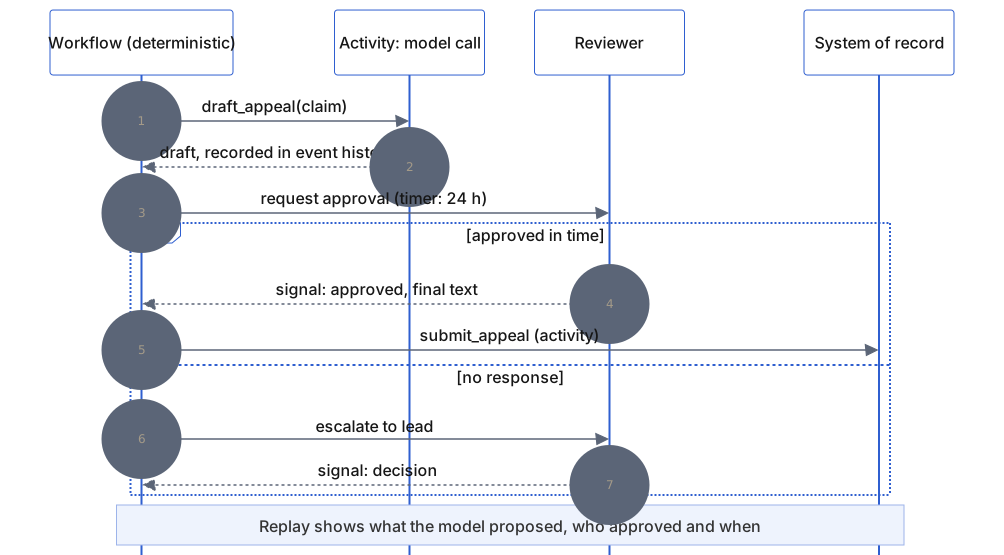
Design choices and trade-offs
| Choice | Trade-off |
|---|---|
| Explicit workflow vs open-ended agent loop | Explicit steps are predictable and auditable; open loops handle unexpected cases but are harder to bound and test |
| Approval on every write vs on selected writes | Every write is safest; selected writes reduce review load once a step has a measured track record |
| MCP vs direct API wrappers | A standard protocol eases reuse across tools; direct wrappers are simpler for one or two systems |
When not to use it
When the process is fully rule-based, write the rules; no model is needed. When a step requires judgement that cannot be checked afterwards, keep a person doing it and use the system to prepare their information.
How we evaluate it
Replay a test set of historical cases through the workflow in a sandbox. Report task completion, the share of steps the model proposed correctly, the share needing human correction, and every case where a proposed action would have been blocked by policy. Security testing includes injected instructions in documents and tool outputs.
Sources
Should you have any questions regarding this page, please contact us at solutions@alesanalytics.com.